Yoker Project Rationale
Why Yoker Exists
Yoker fills a unique gap in the coding agent ecosystem: a library-first, transparent agent harness designed for developers who want full control, visibility, and simplicity.
The Problem
Existing coding agent solutions share common limitations:
Problem |
Examples |
|---|---|
Black box operation |
Claude Code, Cursor, Aider operate opaquely - you can’t see what’s happening inside |
Hidden restrictions |
Claude Code adds “safety” restrictions without transparency |
Complex tool integration |
MCP servers, complex protocols, steep learning curve |
Runtime prompts |
Every dangerous operation requires approval, interrupting autonomous workflows |
Vendor lock-in |
Most solutions mandate a specific LLM provider - you’re locked into their pricing, limits, and terms |
Framework vs Application |
Generic frameworks (OpenAI Agents SDK) require significant coding-specific development |
The Yoker Approach
Core Philosophy: Transparency Over Magic
Everything is open and clear and inspectable, configurable.
No hidden features, no magic sauce.
Yoker believes developers should:
See everything - Full visibility into agent decisions and actions
Configure everything - All behavior controlled via TOML configuration
Understand everything - No hidden features, no opaque restrictions
Architecture: Library-First Design
Yoker is a library, not an application:
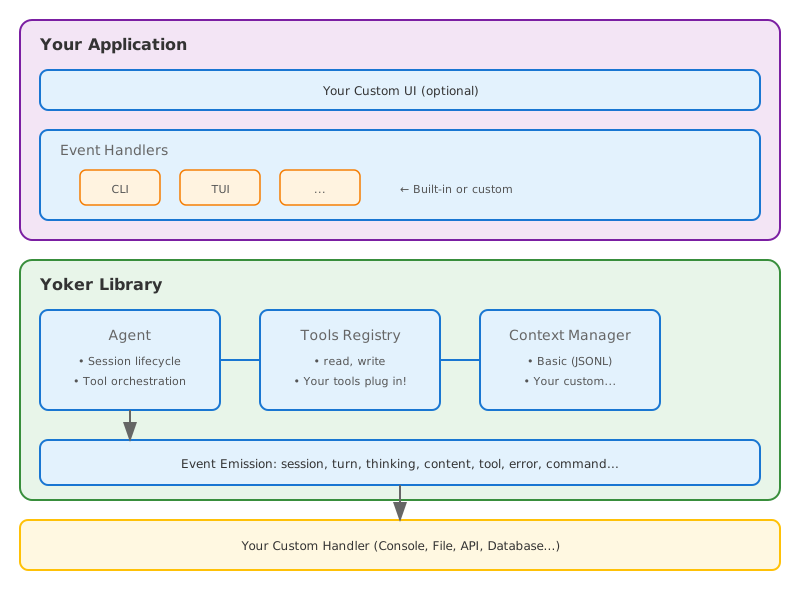
Key difference: Other solutions are applications (CLI/IDE) that you use. Yoker is a library you embed.
Extension points:
UI Layer: Built-in CLI and TUI (via clitic), or plug in your own
Tools: Simple Python functions you register, not MCP servers
Context Manager: Built-in JSONL persistence, or implement your own
Event Handlers: Subscribe to any event stream for custom behavior
Developer-Friendly Tool Registration
# Yoker: Simple Python function with schema-driven guardrails
from typing import Annotated
from yoker.tools.annotations import Path

def read_file(path: Annotated[str, Path("Path to the file to read")]) -> str:
    """Read a file from disk."""
    return open(path).read()

# Other solutions: MCP servers
# - Define server protocol
# - Implement JSON-RPC
# - Handle transport layer
# - Manage server lifecycle
Tools in Yoker are simple Python functions (or callable classes). There is
no base class to inherit from. The Annotated marker on each string parameter
tells the harness which guardrail to apply (Path, Url, Query, or Text).
An optional @tool decorator from yoker.tools.annotations can override the
inferred name or description, but it is not required. No MCP servers, no
complex protocols.
Static Permissions: Predictable Boundaries
Yoker uses static TOML-based permissions instead of runtime prompts:
[permissions]
file_read = ["./src/**", "./docs/**"]
file_write = ["./output/**"]
network_access = "none"
Why this matters:
LLM-based guardrails can be socially engineered or bypassed
Static rules are deterministic - if configured correctly, they’re enforced consistently
No runtime interruptions for “potentially dangerous” operations
Predictable, auditable security boundaries
Important caveat: Static permissions protect operations through Yoker’s tools. A determined agent could:
Generate a Python script that reads files directly (bypassing Yoker’s
readtool)Use subprocess to execute shell commands
Find other creative bypasses
The trade-off: Static permissions provide clear boundaries within the framework, but they don’t replace comprehensive security practices. Tool registration and code inspection are areas for future research.
LLM-Neutral: Choice by Design
Yoker is LLM-neutral by design. No preferred provider, no vendor lock-in - you choose:
[backend]
provider = "ollama"  # or "openai", "anthropic", "gemini", or any litellm provider

[backend.ollama]
base_url = "http://localhost:11434"  # Local
# base_url = "https://ollama.com"  # Cloud

model = "qwen3.5:cloud"  # Your choice
Why this matters:
Your Choice |
Cost |
Privacy |
Performance |
|---|---|---|---|
Local Ollama |
$0 |
100% local |
Slower (current hardware) |
Ollama Cloud |
Free tier available |
No logging by GPU providers |
Fast |
OpenAI / Anthropic / Gemini |
Varies |
Provider’s terms |
Fast |
Any LiteLLM provider |
Varies |
Varies |
Varies |
Note: Ollama guarantees that no information is logged or used by GPU providers when running models on their infrastructure. This is stated clearly on their website.
The fundamental principle: Yoker doesn’t choose for you. You decide:
Which LLM to use
Where it runs (local, cloud, private)
What privacy/cost trade-offs to accept
Privacy is determined by your LLM choice, not by Yoker. Use a local model for maximum privacy, or a cloud provider for speed - Yoker supports both.
Recursive Composition: True Sub-Agents
Yoker’s sub-agents are real, fully-functioning agent instances — not
function calls. They are owned and coordinated by a
:class:yoker.session.Session (MBI-007): an async context manager that
manages a team of agents, their lifecycle, registry, recursion depth
tracking, event aggregation, and inter-agent messaging.
# Multi-agent session in yoker
async with Session(config=config) as session:
    # The primary agent is created by the session and receives the
    # Session-injected SpawnAgent and SendMessage tools.
    agent = await session.create_primary_agent(config=config)

    # Programmatic sub-agent spawn (canonical API, Decision 8). The
    # SpawnAgent tool exposed to the model is a thin wrapper around this.
    researcher = await session.spawn("researcher")
    response = await researcher.process("Summarize README.md")

    # Inter-agent messaging (Decision 3): plain-string request/response.
    reply = await session.send(to=researcher, from_=agent, content="Follow up?")
The Session owns the team: every spawned agent is a full
:class:yoker.agent.Agent instance with its own context, model, tools,
and event stream. Sub-agents are addressable by a unique name the Session
generates (Decision 2), the Session enforces recursion-depth and
max_agents caps, and sub-agent events are aggregated to session-level
handlers — wrapped in a SessionEvent envelope tagged with the source
agent_id so the UI can tell which agent produced what.
Other solutions treat sub-agents as function calls. Yoker treats them as complete agent instances with:
Isolated context (no message leakage)
Configurable model (cheaper model for sub-tasks)
Scoped permissions (sub-agent can’t access parent’s files)
Own event stream (traceable operations, aggregated to the session)
Inter-agent messaging via plain-string request/response (
Session.send(to=, from_=, content=))Allowlist enforcement: each agent definition declares which agents it may spawn through the Session
Target Use Cases
Designed For
Use Case |
Why Yoker |
|---|---|
Embedding in applications |
Library-first design, event emission |
CI/CD automation |
Static permissions, no runtime prompts |
Offline/air-gapped environments |
LLM-neutral, local model support |
Cost-sensitive workflows |
Choose your cost model (local = $0) |
Custom agent-based tools |
Full control, no hidden behavior |
Learning agent architecture |
Transparent, inspectable code |
Not Designed For (Directly)
Use Case |
Better Alternative |
|---|---|
Out-of-the-box interactive coding |
Claude Code, Cursor, Aider |
Multi-agent orchestration platforms |
OpenAI Agents SDK, LangGraph |
General AI framework needs |
Microsoft Agent Framework |
Important nuance: Yoker’s library-first design means you can build your own interactive experience on top of it. Many users want Yoker’s features (improved permissions, flexible tools, no sub-agent restrictions, no hidden manipulation) in their interactive coding sessions - and they can have that by building a UI layer.
The Workflow Model: Interactive ↔ Autonomous
Yoker enables a unique workflow: develop collections interactively, deploy autonomously, return for refinement.
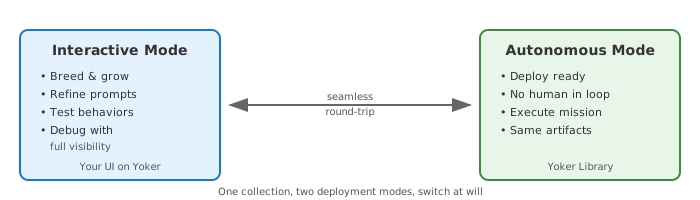
This changes how you build agent systems:
Not “build for interactive” vs “build for autonomous”
Build once in interactive mode, deploy to autonomous
The UI becomes your development environment, not your runtime constraint
Return to interactive anytime for refinement and bug fixes
Key Differentiators Summary
Aspect |
Yoker |
Others |
|---|---|---|
Architecture |
Library |
Application |
Visibility |
Full event stream |
Black box |
Context |
No hidden manipulation |
Secret instructions |
Permissions |
Static TOML (deterministic) |
Runtime prompts (bypassable) |
Tools |
Python functions with guardrail markers |
MCP servers |
LLM Provider |
Your choice (Ollama, OpenAI, Anthropic, Gemini, 100+) |
Vendor’s choice |
Cost |
Your choice |
Vendor pricing |
Privacy |
Your choice |
Vendor’s terms |
Sub-agents |
Full instances, coordinated by a Session |
Function calls |
Workflow |
Interactive ↔ Autonomous |
Fixed mode |
Transparency |
100% |
Varies |
Conclusion
Yoker exists because developers need a transparent, controllable, library-first agent harness that respects their autonomy and intelligence. No hidden restrictions, no magic sauce - just clear, inspectable code that does exactly what you configure it to do.
“Everything is open and clear and inspectable, configurable. No hidden features, no magic sauce.”